


6 Conditions for Successful Marketing: A Practical Guide
🏁 Introduction
A successful marketing strategy does more than promote a product or service. It connects the right offer with the right audience, through the right channel, at the right stage of the buying journey. To achieve sustainable growth, businesses need clear objectives, customer research, consistent messaging, measurable campaigns, and a process for continuous improvement.
In this guide, we explain six practical conditions for successful marketing and show how businesses can turn them into measurable actions.
In this article, the six essential conditions that can improve marketing clarity, consistency, and measurable performance when applied to the right market and business model — powered by the expertise of Nourline Digital Marketing.
01
🎯 1. Define Your Goal Clearly: Start with “Why?”
Every successful marketing campaign begins with a simple question: What do I want to achieve?
Do you aim to increase sales? Build brand awareness?
Before choosing a platform or launching a campaign, review your current position. Study your market, competitors, customer needs, existing traffic sources, and previous campaign results. This information helps you set realistic objectives and identify a clear opportunity for differentiation.
Use SMART objectives to turn a general ambition into a measurable plan. For example, instead of saying “increase sales,” define a target such as: “Generate 50 qualified leads from Google Ads within 60 days while keeping the cost per lead below the approved target.”
Specific – Measurable – Achievable – Realistic – Time-bound.
02
👥 2. Understand Your Target Audience: Know Who You’re Talking To
The biggest mistake in marketing is trying to talk to everyone — because that means reaching no one.
Successful marketing depends on deep understanding of your audience —
Build a buyer persona using information such as industry, location, company size, job role, purchasing power, common problems, objections, preferred content formats, and the channels used during research. Then separate audiences by awareness and intent: people who are discovering the problem, comparing solutions, or ready to contact a provider.
Every piece of information about your audience helps you craft more persuasive messages and design better-performing ads.
Nourline uses data analysis and digital behavior tracking to accurately define your ideal customer (Buyer Persona).
03
🧭 3. Choose the Right Marketing Channels
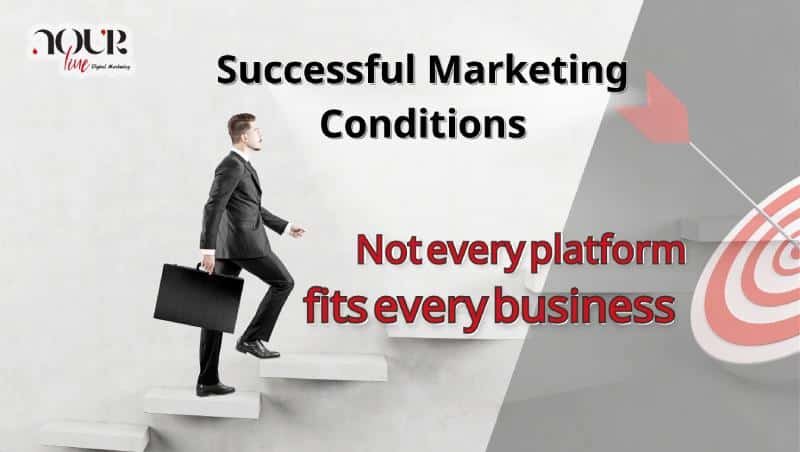
Not every platform fits every business.
- If your audience consists of companies, LinkedIn may be ideal.
- If your products are visual or aimed at the general public, Instagram and Facebook are better choices.
- Google Ads can help capture existing demand when people are actively searching for a solution, while social media can support awareness, education, retargeting, and community building. The best channel depends on search demand, audience behavior, offer type, sales cycle, budget, and the quality of the landing page.
True success lies in selecting the right platform at the right time, and integrating multiple channels within a unified strategy.
04
💡 4. Create Valuable, Persuasive Content
Content is the heart of digital marketing. ❤️
Valuable content should connect a customer problem with a clear solution. It should explain the benefit of the offer, show why the business is credible, address common objections, and guide the reader toward a logical next step. Content works best when it supports the entire buying journey, from awareness to consideration and conversion.
Your content should be:
✅ Useful and truly valuable
✅ Consistent with your brand identity
✅ Easy to read and visually appealing
✅ Optimized for search engines (SEO)
At Nourline, we craft content that “speaks your brand’s voice” and turns visitors into customers through well-planned steps.
05
📊 5. Analyze Performance and Measure Results
Analysis isn’t the final step — it’s an ongoing process. 🔄
The difference between random marketing and successful marketing lies in continuous analysis.
Using tools like Google Analytics and Meta Insights, you can track:
• Traffic sources
• Engagement rates
• Cost per acquisition
• Return on investment (ROI)
Nourline helps you understand every step in your campaign and continually improve it.
06
🧠 6. Continuous Development and Experimentation
Markets evolve, audiences change, and platforms develop daily.
That’s why successful marketing doesn’t stop at one plan — it relies on continuous testing and innovation.
Test one meaningful variable at a time whenever possible. You can compare headlines, offers, creative formats, audiences, landing pages, or calls to action.
Record the result, identify the reason for the change, and apply the insight to the next campaign. Testing should improve business performance, not simply increase activity.
🚀 Conclusion: Successful Marketing Starts with the Right Plan
In the end, the conditions for successful marketing are not a secret, but they do require expertise and smart execution.
At Nourline Digital Marketing, we help you succeed through carefully crafted strategies that include:
• Search Engine Optimization (SEO)
• Advertising Campaign Management
• Website and E-Commerce Design
• Content and Video Production
• Visual Identity and Branding
Successful marketing starts with a clear objective, a strong understanding of the customer, a focused offer, the right channels, and a measurement process that turns data into decisions. Results will depend on the market, budget, offer, execution, and consistency, but a structured approach makes improvement possible.
Want a marketing plan built around your goals? Contact Nourline for a free strategy consultation. Our team can help with SEO, paid advertising, website and e-commerce design, content production, and brand identity.
🔗 Discover Nourline’s services now!
Want a marketing plan built around your goals? Contact Nourline for a free strategy consultation.
External References
- ArtStep Company – Contracting and Construction Solutions (https://artstepegypt.com/)
- United Company – Measurement Systems and Sensors (https://unitedeg-co.com/)
- Nourline Company (https://nourline.com/)
- Kayan Company for Safety Devices and Fire and Smoke Curtains (https://kayancomp.com/)